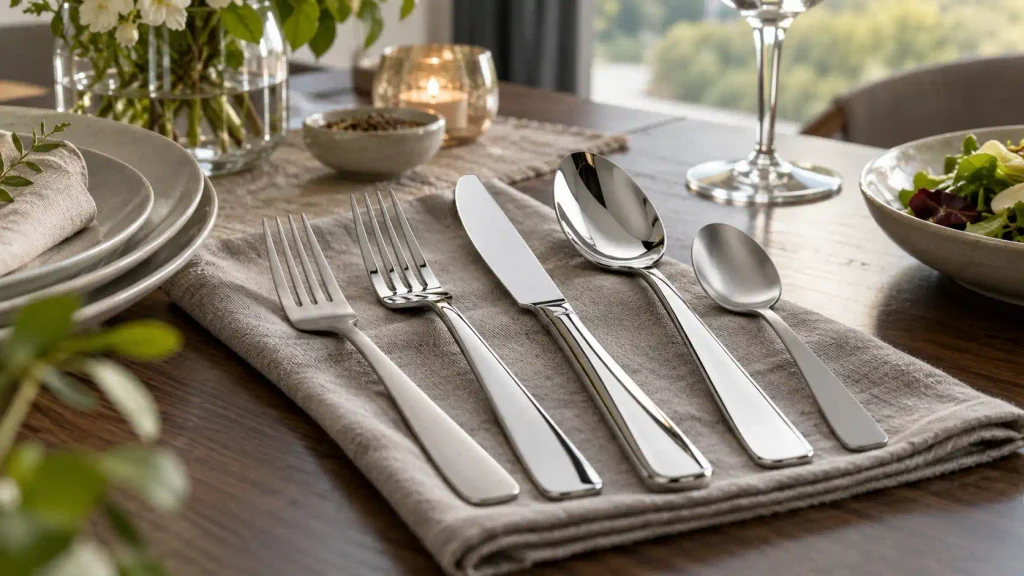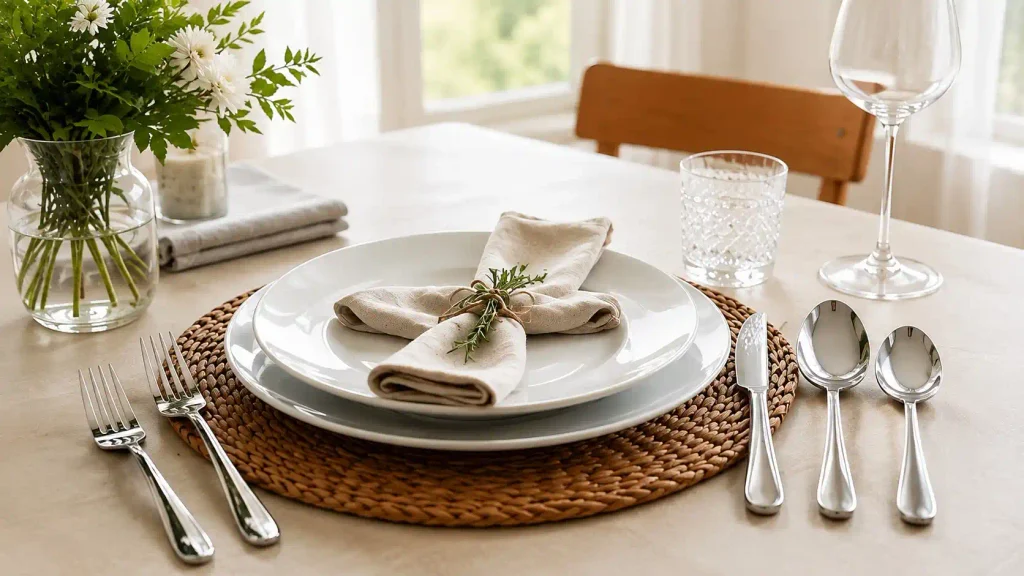
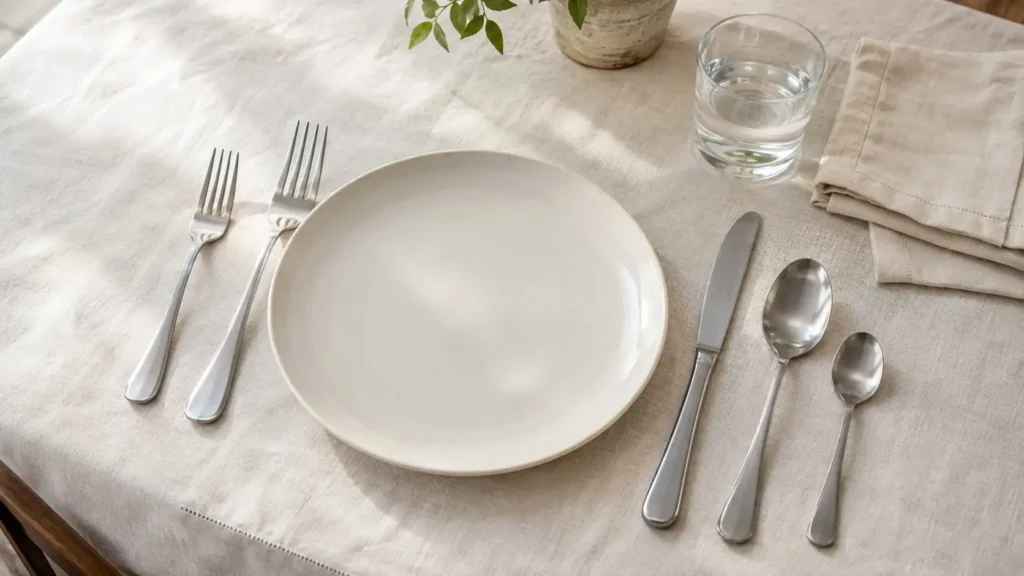
Flatware, silverware, and cutlery loosely mean the same thing to us: the forks, knives, and spoons we use at the table. In homes, restaurants and stores, we often switch between these words without giving them much thought.
But these names hide a few apparent surprises. A steel fork may be called silverware even though it doesn’t contain an iota of silver! A curved spoon can be flatware, although it isn’t flat! And cutlery can include spoons, although they don’t cut anything!
So, what is flatware, and is it truly exactly the same as silverware and cutlery? Well, the answer depends on the material, place, and way the item is used.
In this guide, you’ll discover what flatware actually means, what comes in a flatware set, and how it differs, if at all, from silverware, cutlery, dinnerware, and glassware. In broader context, we’ll also enlighten you on common metals used, 18/10 steel, silver value, and the pieces used at everyday and formal meals.
⚡What Is Flatware in Simple Words?
Flatware means the hand-held tools used to eat and serve food.
In most American homes, it means to consist of forks, table knives, and spoons. Moreover, serving forks, ladles, butter knives, and pie servers are also part of a larger flatware set.
Actually, the word doesn’t tell you about metal composition of the products. Flatware can very well mean stainless steel, sterling silver, silver plate, plastic, wood, bamboo, or another food-safe material.
People often use flatware, silverware, and cutlery for the same things. That is quite acceptable in daily conversation. However, these words have different histories and slightly different meanings. So, questions like “define flatware,” “what is flatware called,” and “what does silverware mean” need need a closer look. Later in this article, we’ll show where these terms overlap and where they differ. For now, let’s have a glance at quick answers to some common questions in this regard.
| Question | Short answer |
|---|---|
| What is flatware? | Forks, table knives, spoons, and related serving tools. |
| Is all flatware silver? | No. Most modern sets are stainless steel. |
| Are plates flatware? | Usually no. Plates are dinnerware. |
| What is an everyday set? | A group of matching utensils for each person at the table. |
🗣️ Flatware Meaning and Definition
One of the simplest definitions of flatware is “utensils used at the table.”
The word utensil is rather broad. A whisk is a utensil too, but it’s not normally considered flatware. Flatware is meant for eating, serving, or table use.
However, there is one caveat. In some section of tableware trade, flatware can mean flat ceramic pieces, such as plates. These pieces are, of course, distinct from hollow bowls, cups, and pots.
However, this is not the way most American shoppers use the word. They basically mean forks, knives, and spoons.
📜 Why Is It Called Flatware?
The name originated from the way table goods were once grouped.
Flat items were placed separate from hollow vessels. Bowls, pitchers, pots, and sugar bowls were termed hollowware.
However, these days, shape is not a strict criterion. A spoon still counts as flatware, though being curved in shape. The old trade name remained, while its meaning became wider.
👨🍳 What Is Flatware in Food and Beverage Service?
In food and beverage industry, flatware means the eating and serving tools placed for a guest.
Hotels, restaurants, caterers, cruise ships, and banquet halls use this name quite often.
The combination of pieces depends on the menu. A café would like to set just one fork, one knife, and one spoon. A formal dinner would most likely add a salad fork, fish knife, soup spoon, and dessert spoon.
In these services, placement matters too. For example, forks usually sit to the left of the plate, while knives and spoons lie on the right side. One would begin with the pieces farthest from the plate and proceed inward as courses are served. See the full guide to setting flatware on a table for casual and formal flatware setting.
🥄 What Are Some Different Examples of Flatware?
When you open a normal kitchen drawer, you may see only four shapes. But, when you open a catering case, the list is long. Each piece may have a small role in the dinner.
| Piece | Usual job | Where you may see it |
|---|---|---|
| Dinner fork | Main meal | Almost every place setting |
| Salad fork | Salad or starter | Multi-course meals |
| Dinner knife | Cuts soft food and meat | Everyday and formal meals |
| Steak knife | Cuts firm meat | Steakhouses and home meals |
| Teaspoon | Stirs drinks and eats small desserts | Daily use |
| Soup spoon | Lifts soup or broth | Soup courses |
| Dessert fork | Cake, pie, or pastry | Dessert service |
| Serving spoon | Moves food from a shared dish | Family and buffet meals |
Some sets also comprise iced-tea spoons, seafood forks, butter spreaders, sugar spoons, ladles, and pie servers.
These various types of flatware cover most home and restaurant meals. There is no need for all of them for a normal dinner.
To find the right item online, precision matters. If you search “what are cutlery,” you may not get the appropriate results that would come from the search of the natural forms like “what is cutlery?” and “what are cutlery items?”
If you want to be more confident in using flatware correctly, read our simple guide to using silverware.
📦 What Is a Flatware Set?
A flatware set may be defined as a group of matching forks, knives, and spoons. Most boxed sets sell by the number of people they serve.
A common five-piece place setting has:
- A dinner fork
- A salad fork
- A dinner knife
- A tablespoon
- A teaspoon
A 20-piece set usually serves four people. Similarly, a 40-piece set often serves eight.
Don’t always trust the piece count by itself. A 45-piece box may contain 5-piece settings for eight people plus five serving tools.
You must read the list on the box. That small check can save a return hassle.
| Common label | Likely service | What to check |
|---|---|---|
| 5 pieces | 1 person | One full place setting |
| 20 pieces | 4 people | Whether tablespoons are included |
| 40 pieces | 8 people | Whether serving pieces cost extra |
| 45 pieces | Often 8 people | The five added serving tools |
| 60–65 pieces | Often 12 people | Exact place and serving piece count |
🏭 What Is Flatware Made Of?
Most of flatware for daily use is made of stainless steel. The steel normally contains iron and a little bit of chromium.
Chromium contributes to forming a thin shield on the surface. This coating slows rust and stains.
Even then, “stainless” does not mean absolutely “stain-proof.” Deposit of salt, bleach, long soaking, hard water, and old food can very well cause spots or damage to the stainless steel.
Older, heirloom sets may be composed of sterling silver or silver plated. Sterling silver is an alloy containing as much as 92.5% real silver.
Silver plate, on the other hand, has a thin silver layer over a base metal. Once that layer wears out, the metal below starts to reveal itself.
Then, what is silverware made of? Actually, modern-day silverware is often stainless steel. Older sets may be sterling or silver plate.
There may be intriguing questions like “what is flatware silver.” With such a question, the searcher usually wants to know whether flatware contains real silver. The most plausible answer is: flatware hardly contains real silver.
| Material | Strong point | Limit | Common use |
|---|---|---|---|
| Stainless steel | Strong and easy to care for | Can spot or rust if poorly treated | Daily meals |
| Sterling silver | Has real silver content and may hold value | Tarnishes and scratches more easily | Special meals and collections |
| Silver plate | Gives a silver look with less silver | The thin coating may wear away | Decorative and older sets |
| Plastic or plant fiber | Light and easy to carry | May bend, break, or be single-use | Picnics and takeout |
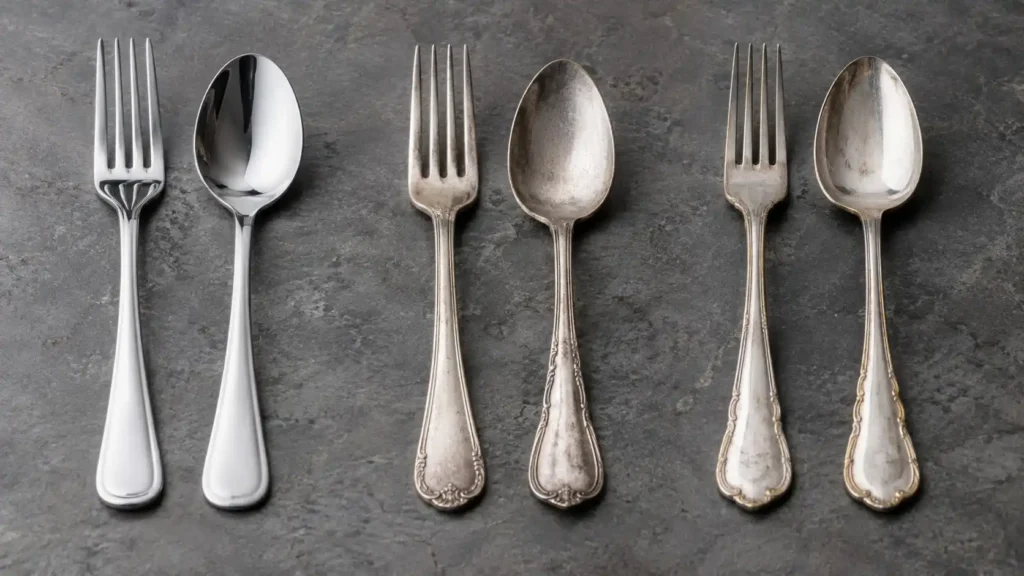
For a closer look at metal choices, read the comparison of stainless steel and sterling silver flatware.
🔢 What Does 18/10 Mean in Flatware?
The mark 18/10 usually indicates the content of about 18% chromium and about 10% nickel in the stainless alloy.
Presence of chromium helps in fighting corrosion of the metal. Presence of Nickel gives the metal shine and helps the steel resist wear.
There are other somewhat lower steel grades such as 18/8 and 18/0. These labels may be useful, but they are not an absolute and final full report card.
Various factors such as steel thickness, shape, finish, factory control, and knife construction also matter in how a set performs.
An important point to note: knives may use a grade different from that for the forks and spoons in the same set.
This is because a knife blade requires a harder edge. As a result, it’s not wise to assume every piece of the box use the same material.
| Mark | Rust and stain resistance | Finish | Watch for |
|---|---|---|---|
| 18/10 | Usually very good | Often bright and smooth | Nickel sensitivity and higher cost |
| 18/8 | Usually very good | Often close to 18/10 | The label says little about thickness |
| 18/0 | Fair to good with proper care | May look less warm or bright | More chance of spotting in harsh conditions |
⚖️ Flatware vs Silverware vs Cutlery
The three words overlap. Region and setting change how people use them.
| Word | Older or strict meaning | Common meaning today |
|---|---|---|
| Flatware | Flat table goods, set apart from hollowware | Forks, table knives, and spoons |
| Silverware | Items made from or coated with silver | Any household eating utensils |
| Cutlery | Cutting tools, mainly knives | Knives, forks, and spoons, mainly in British English |
🩶 What Is Flatware vs Silverware?
The main difference between flatware and silverware stems from the original link to silver.
Genuine silverware is made of silver or covered with it. Flatware actually means the type of table tool, not its metal.
In casual American usage, people say “silverware” even when the fork is stainless steel. No one at dinner is likely to have any problem with it.
However, at the time of buying, selling, or valuing old pieces, the difference matters a great deal.
🔪 What Is Flatware vs Cutlery?
Cutlery in the past centered on knives and cutting tools only.
In British vocabulary, it now commonly includes knives, forks, and spoons. In American retailers, flatware is the more common label for a matching table set.
On the internet, people keep searching “cutlery vs silverware” and “cutlery vs flatware.” But, the answer boils down to the same comparison as above.
Another somewhat strange question: “what is flatware cutlery” brings the answer that forks, knives, and spoons are marketed under both names.
🍽️ Flatware vs Dinnerware, Glassware, and Crockery
A dining table has several types of items. They are given names based on what they do and, at times, what they are made from.
| Group | What belongs in it | Easy memory clue |
|---|---|---|
| Flatware | Forks, table knives, and spoons | Tools held in the hand |
| Dinnerware | Plates, bowls, and serving dishes | Holds the food |
| Glassware | Tumblers, goblets, and wine glasses | Holds the drink |
| Crockery | Ceramic plates, cups, bowls, and dishes | Ceramic table pieces |
🍽️ Are Plates Considered Flatware?
Normally, no. A plate is part of dinnerware. For example, a fork is flatware, and not dinnerware..
It’s possible that you may see a different usage in a pottery catalog. In that case, flat ceramic pieces may fall under category of flatware.
For a normal home, restaurant, or online store, plates and bowls belong to the dinnerware group.
🥂 What Are Flatware and Glassware?
Flatware helps you eat food. Glassware lets you drink a liquid.
These words are not mutually inclusive.
As examples, we may mention a spoon as a piece of flatware or cutlery; a water goblet as an item of glassware; and a soup bowl as part of dinnerware or crockery.
✅ What Is Good Flatware?
Good flatware feels comfortable in the hand. It doesn’t tip backward. The tines of the fork are even.
The edges are smooth. The spoon bowl shouldn’t feel sharp on the mouth.
People also keep asking what is good silverware. In fact, the answer is the same.
To indentify good flatware, we need to consider the metal, shape, finish, balance, and pieces in the box. To test, hold the knife as if you are cutting a potato. Then lift the spoon like it holds soup.
A beautiful handle can feel tiring after two minutes. Your hand may feel what a photo may hide.
Check these points:
- Balance: The handle should not pull hard in one direction.
- Finish: Edges and gaps should feel smooth.
- Strength: A fork should not bend with light pressure.
- Set mix: Buy the pieces your family will use.
- Care: Read the maker’s washing and cleaning notes.
- Replacement: A lasting pattern is easier to add to later.
🏋️ What Is a Good Weight for Stainless Flatware?
There is no single perfect weight.
“Light,” “medium,” and “heavy” are not fixed grades shared by every brand. A short spoon may weigh more than a long one because its handle is thicker.
Medium-weight pieces suit many homes. They feel steady without tiring the hand.
Heavy pieces can feel rich, but children and older adults may prefer less weight.
Balance matters more than a number on a scale. A well-shaped light fork may feel better than a thick fork with a heavy end.
🛡️ What Is the Best Stainless Steel for Flatware?
If your question is “what is best stainless steel for flatware,” 18/10 is a strong daily-use choice for many homes.
It tends to keep a bright finish and resist corrosion well. Good 18/8 can perform in much the same way.
Well-made 18/0 can also serve a family for years. It has no added nickel in the grade label and often costs less.
Still, what is good stainless steel flatware depends on thickness, balance, finish, and construction as well as grade.
The grade is only one clue. Thick steel with rough edges is still poor flatware. Thin steel with a famous name can still bend.
💰 What Is Sterling Silver Flatware Worth?
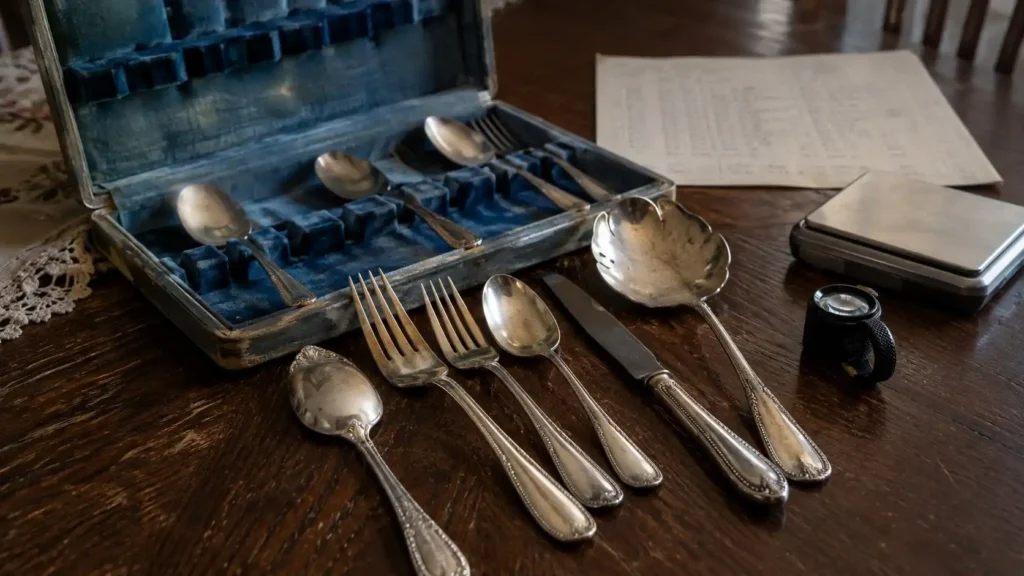
Sterling flatware does not have one fixed value.
The answer changes with silver prices, weight, maker, pattern, age, condition, and buyer demand.
If you are asking what is silverware worth, find the metal first. Stainless steel, silver plate, and sterling can look alike from across the room.
Their resale values can be far apart.
What is silver flatware worth? First, confirm whether the pieces are sterling or merely silver-plated.
The answer to “what is the value of sterling silver flatware” then depends on silver weight, pattern, maker, condition, and demand.
Look for a mark such as “Sterling” or “925.” Do not treat “EPNS,” “A1,” “silver plate,” or a maker’s name as proof of solid sterling.
The guide on how to tell if flatware is real silver explains the common checks.
Count every piece and note the pattern. A complete set may bring more than a broken group.
Rare serving pieces can matter to a collector even when they do not weigh much.
Here is the trap: do not place a sterling-handled knife on a scale and call its full weight silver.
Many knives have steel blades. Some handles are hollow or filled with another material. A buyer must account for that before giving a melt estimate.
| Clue | Effect on value | Risk |
|---|---|---|
| Clear “Sterling” or “925” mark | Supports real silver content | Marks can be worn or faked |
| Complete named pattern | May add collector value | Demand changes by pattern |
| Deep wear or damage | Often lowers resale value | Repair may cost more than expected |
| Silver-plated mark | May have pattern or use value | Usually little precious-metal value |
Silver plate can still be useful or collectible. It just should not be priced like sterling.
Read these facts about silver-plated silverware and value before selling an old set.
🛒 How Do You Choose a Flatware Set?
Start with the way you eat.
A family of four that runs the dishwasher every other day may need eight place settings, not four. Extra teaspoons also disappear into lunch bags and coffee cups.
- Count the people you serve most often.
- Add a few spare place settings for guests.
- Choose steel, silver, or another material.
- Hold one piece before buying when possible.
- Check the exact pieces inside the box.
- Read the cleaning rules.
- Look for open-stock pieces if replacements matter.
Readers looking for the best flatware sets for everyday use should start with comfort, set size, and care needs.
The best flatware brands are not always the most costly ones. Replacement pieces and steady quality matter more than the name alone.
You can also browse the site’s best flatware sets and read the long-term cost guide to premium flatware.
🧼 How Should You Care for Flatware?
Match the care method to the metal.
Stainless steel is forgiving. Sterling and silver plate need a softer touch.
| Habit | Why it helps | What to avoid |
|---|---|---|
| Rinse off salty or acidic food | Cuts the time food touches the metal | Leaving dirty pieces overnight |
| Dry pieces soon after washing | Helps stop water spots | Long wet soaking |
| Use a soft cloth on silver plate | Protects the thin silver coat | Steel wool and rough powder |
| Follow the maker’s dishwasher note | Coatings and handles vary | Assuming every set is dishwasher-safe |
For stains, tarnish, and rust spots, use a method suited to the metal.
The full silverware cleaning guide covers stainless steel, sterling, silver plate, and coated pieces.
🚫 Flatware Mistakes That Cost Time or Money
- Calling every shiny piece sterling: Stainless steel and silver plate can look alike in a photo.
- Buying by piece count alone: The box may contain serving tools you do not need.
- Thinking 18/10 means perfect: The grade cannot fix thin metal, rough edges, or weak design.
- Using harsh cleaners: A rough pad can scratch steel and wear through silver plate.
- Valuing knives by full weight: The blade and handle filling may not be silver.
- Ignoring comfort: A bold handle may press into the palm during a long meal.
🎯 Final Thoughts
So, what is flatware?
It is the group of forks, table knives, spoons, and related tools used for eating and serving food.
The name does not promise real silver. It also does not cover every object on the table.
Plates are dinnerware. Drinking vessels are glassware. Crockery is ceramic tableware.
Once those groups are clear, labels become easier to read. So do old hallmarks, hotel place settings, and the small print on a 45-piece box.
📚 Keep Reading
- How to Set Flatware on a Table
- How to Use Silverware
- How to Clean Silverware
- How to Tell If Flatware Is Real Silver
- More Flatware Guides
❓ Frequently Asked Questions
🧲 Can a Magnet Tell Whether Flatware Is Good?
No. A magnet is not a quality test.
Some types of stainless steel attract a magnet. Others show little or no pull. Knife blades may also react differently from the forks and spoons in the same set.
Use the magnet as one small clue. Check the mark, finish, weight, construction, and maker too.
🍴 What Is Open-Stock Flatware?
Open-stock flatware is sold one piece at a time.
You can replace a lost teaspoon or add dinner forks without buying another full box. This is useful because small pieces tend to vanish first.
Before choosing a pattern, check whether single replacement pieces are still sold.
🌈 Why Does Stainless Flatware Develop Rainbow Marks?
Rainbow marks may come from heat, minerals, or a thin detergent film. They do not always mean the steel is damaged.
A soft cloth and diluted white vinegar may remove the color from plain stainless steel. Rinse and dry the piece after cleaning.
Do not use this method on coated, gold-plated, or silver-plated pieces unless the maker allows it.
🧺 Should Flatware Point Up or Down in the Dishwasher?
Place sharp knife points downward for safety.
Forks and spoons should have enough space between them for water to reach every surface. Some dishwasher makers suggest mixing them so the pieces do not nest together.
Always follow the instructions for both the dishwasher and the flatware.
⚡Can Sterling Silver and Stainless Steel Touch in the Dishwasher?
It is better to keep them apart.
Different metals may react when they touch in hot water and strong detergent. This can leave marks or discoloration.
Sterling silver and silver-plated pieces are usually safer when washed by hand with mild soap.
🧒 What Flatware Is Easier for Children or Older Adults to Hold?
Look for rounded edges, medium or light weight, and handles that are not too thin.
A thick handle can be easier to grip. A very heavy handle may tire the hand.
Hold one piece before buying when possible. Comfort matters more than appearance here.
🔄 Can You Mix Two Flatware Patterns?
Yes. Mixed flatware can look natural when the pieces share one feature.
You might repeat the same metal color, finish, handle shape, or level of detail.
For example, two plain stainless patterns often work better together than one plain pattern and one highly decorated gold pattern.
⏳ How Long Can Stainless Steel Flatware Last?
Well-made stainless steel flatware can last for decades.
Its life depends on the steel, thickness, finish, washing method, and daily use. Quick rinsing, proper drying, and gentle cleaning help it last longer.
Discover more from Flatware Finesse
Subscribe to get the latest posts sent to your email.