Executive Summary
Premium flatware occupies a unique position in the home goods market.
Unlike many kitchen products that are replaced frequently, flatware is expected to last years or even decades. Consumers searching for premium flatware, high end flatware, and luxury flatware brands are usually not only looking for forks and knives.
They are looking for:
- better materials
- better hand feel
- improved durability
- attractive table presentation
- long-term value
However, a higher price does not automatically guarantee a better ownership experience.
A $900 designer flatware set may outperform a $200 set in appearance but may not provide nine times the practical value.
This research examines premium flatware through five dimensions:
- Material quality
- Construction quality
- Long-term ownership economics
- Professional testing results
- Consumer experience patterns
Professional testing sources consistently emphasize that quality flatware is not defined only by price. Important factors include weight, balance, comfort, finish quality, and stainless steel composition. Serious Eats tested 13 flatware sets and evaluated factors including balance, durability, comfort, and aesthetics.
Research Methodology
Research Question
Are premium flatware sets worth their higher price compared with mid-range alternatives?
Evidence Sources Used
This analysis combines:
1. Professional Testing
Professional reviewers evaluate:
- comfort
- weight
- balance
- dishwasher performance
- durability
- design
Examples:
- Serious Eats tested multiple flatware sets and highlighted balance, weight, comfort, and 18/10 stainless steel construction as important quality factors.
- Bon Appétit evaluated flatware sets through repeated home use, dishwasher cycles, comfort, and durability.
2. Material Research
Premium flatware is often associated with:
18/10 stainless steel
Meaning:
- 18% chromium
- 10% nickel
Chromium improves corrosion resistance, while nickel improves shine and resistance to corrosion.
3. Consumer Sentiment Analysis
Consumer discussions commonly focus on:
Positive themes:
- beautiful design
- comfortable weight
- premium feel
- long-term satisfaction
Negative themes:
- scratches
- finish problems
- difficult replacement
- decorative handle maintenance
These comments are used to identify patterns, not to create artificial statistical scores.
What Does “Premium Flatware” Actually Mean?

The term premium flatware covers several different categories.
Premium Flatware Categories
| Category | Main Selling Point | Typical Buyer |
|---|---|---|
| Premium Stainless Steel | Material quality and durability | Daily users |
| Designer Flatware | Unique appearance and personality | Design-conscious buyers |
| Luxury Heritage Flatware | Craftsmanship and prestige | Collectors and formal dining users |
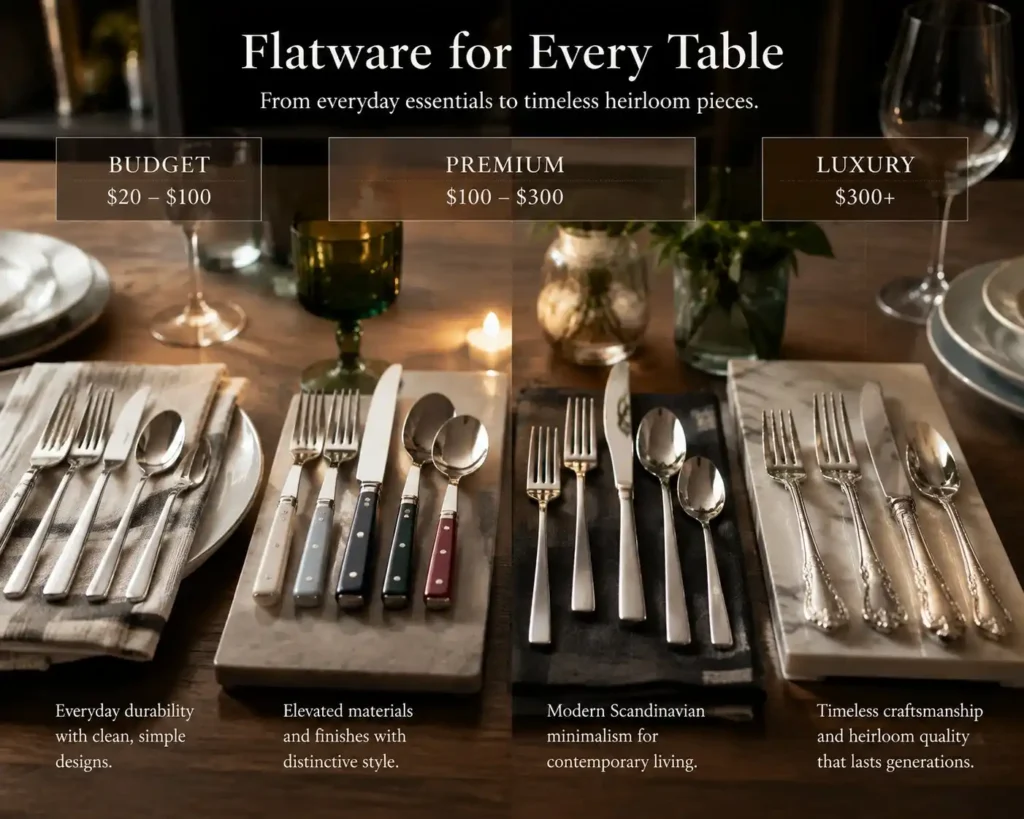
The Premium Flatware Price Pyramid
$800+
$300–$800
$100–$300
Under $100
Why Consumers Pay More for High End Silverware
Premium buyers usually pay for five things:
| Value Factor | Why It Matters |
|---|---|
| Material | Higher-grade stainless steel and better corrosion resistance |
| Weight | A heavier, balanced feel often creates a premium impression |
| Design | Distinctive shapes and finishes improve table aesthetics |
| Craftsmanship | Better finishing and quality control |
| Longevity | Potential for decades of use |
18/10 Stainless Steel: The Premium Benchmark
Not all stainless steel flatware is identical.
| Steel Type | Composition | Typical Positioning |
|---|---|---|
| 18/0 | 18% Chromium, little/no Nickel | Entry to mid-range |
| 18/8 | 18% Chromium, 8% Nickel | Premium quality |
| 18/10 | 18% Chromium, 10% Nickel | High-quality premium flatware |
18/10 stainless steel is widely considered a benchmark for higher-quality flatware because nickel improves shine and corrosion resistance.
However, consumers comparing premium materials should also understand the differences between stainless steel and precious metals. Our guide on stainless steel vs sterling silver flatware explains durability, maintenance requirements, appearance, and long-term ownership considerations.
Expert Testing: What Actually Matters?
A major finding from professional reviews is that expensive appearance alone does not determine quality.
The strongest recurring evaluation criteria are:
| Factor | Importance |
|---|---|
| Balance | Very High |
| Comfort in hand | Very High |
| Steel quality | Very High |
| Dishwasher performance | High |
| Visual design | Personal preference |
The Real Question: Is Expensive Flatware Actually Better Value?
When consumers search for:
- premium flatware
- high quality flatware sets
- luxury flatware brands
- best quality flatware
they are often trying to answer a financial question:
“If I spend more today, will I actually get better value over time?”
The answer depends on three variables:
- Initial purchase price
- Useful lifespan
- Maintenance and replacement costs
A premium flatware set is not automatically a better investment. However, a well-made set can become economical if it remains attractive and functional for many years.
10-Year Ownership Cost Model
Important note:
The following model is an ownership scenario, not a claim that every brand lasts exactly this long.
Assumptions:
- Family household
- Daily use
- Complete place setting purchase
- Replacement occurs when the set is no longer satisfactory
Ownership Cost Comparison
| Category | Typical Purchase Price | Possible Useful Life | 10-Year Ownership Cost | Cost Per Year |
|---|---|---|---|---|
| Basic Flatware | $50-$100 | 3-5 years | $100-$300 | $20-$60/year |
| Mid-Range Quality Flatware | $150-$300 | 8-12 years | $150-$300 | $15-$38/year |
| Premium Flatware | $300-$800 | 10-20+ years | $300-$800 | $20-$80/year |
| Luxury Flatware | $800+ | 20+ years | $800+ | $40+/year |
Cost Per Year Chart
Basic
Mid-Range
Premium
Luxury
Finding: Premium Does Not Always Mean Cheapest
The ownership model reveals an important point:
A premium flatware set can last longer, but the initial investment remains significant.
For example:
A $600 premium set lasting 15 years:
$600 ÷ 15 = $40/year
A $250 mid-range set lasting 10 years:
$250 ÷ 10 = $25/year
The mid-range set may actually have the lower financial cost.
So why do people buy premium?
Because value is not only financial.
The Four Types of Flatware Value
1. Financial Value
Question:
“How much does ownership cost?”
Measured by:
- purchase price
- replacement frequency
- availability of individual pieces
2. Functional Value
Question:
“How does it perform every day?”
Measured by:
- balance
- comfort
- knife performance
- dishwasher tolerance
3. Design Value
Question:
“Does it improve the dining experience?”
Measured by:
- appearance
- uniqueness
- table presentation
4. Emotional Value
Question:
“Will I still enjoy owning it years later?”
Measured by:
- attachment
- craftsmanship appreciation
- brand heritage
Consumer Sentiment Analysis: What Owners Actually Care About
Across public consumer discussions and product reviews, several themes appear repeatedly.
Positive Patterns
1. Weight and Balance
Many premium flatware owners appreciate:
- substantial feel
- comfortable grip
- balanced handling
This aligns with professional testing, where balance and comfort are often key evaluation criteria.
2. Design and Appearance
Designer brands receive strong appreciation because they make flatware part of the dining environment.
Common positive themes:
- beautiful design
- unique appearance
- compliments from guests
- personalization options
Indeed, designer brands such as Sabre Paris compete more through personality, customization, and table styling rather than traditional luxury craftsmanship. Our detailed Sabre flatware quality analysis examines design strengths, and weaknesses across multiple collections.
For a practical example of designer premium flatware, our Sabre Bistrot flatware review explores its design appeal, construction quality, durability, and suitability for everyday use.
3. Longevity
Long-term owners often value:
- keeping the same pattern for many years
- adding replacement pieces
- avoiding repeated purchases
Common Consumer Complaints
1. Maintenance Problems
Premium does not eliminate maintenance.
Common complaints include:
- water spots
- scratches
- finish changes
- special cleaning requirements
Even high-quality flatware requires proper care to maintain its appearance. Our guide on how to clean silverware without damaging the finish provides practical advice for preserving different types of flatware.
2. Replacement Difficulty
This is an underestimated issue.
A premium set may become inconvenient if:
- patterns are discontinued
- individual pieces are unavailable
- collections change frequently
3. Knife Performance
Flatware knives are often the weakest part of many sets.
Consumers frequently judge knives separately because:
- table knives are not always designed for serious cutting
- serration quality varies
- expectations differ
Premium Brand Positioning Analysis
| Brand Category | Main Strength | Main Buyer |
|---|---|---|
| Designer Premium | Appearance and personality | Style-conscious households |
| Engineering Premium | Material and durability | Everyday users |
| Luxury Heritage | Craftsmanship and prestige | Collectors and formal dining |
Brand Comparison Overview
| Brand | Position | Strength | Potential Weakness |
|---|---|---|---|
| Sabre Paris | Designer Premium | Color, customization, distinctive design | Some finishes require more care |
| WMF | Premium Practical | Engineering reputation, stainless steel expertise | Less decorative |
| Villeroy & Boch | Premium Lifestyle | Design and everyday usability | Higher pricing |
| Robert Welch | Design Premium | Ergonomics and modern styling | Availability varies |
| Zwilling | Functional Premium | Manufacturing reputation | Less artistic variety |
| Christofle | Luxury Heritage | Craftsmanship and prestige | Very expensive |
If you want to read detailed reviews of individual sets from a wider collection before purchasing, explore our complete collection of flatware reviews and comparisons covering design, materials, performance, and value.
The Best Brand Flatware Decision Framework
| Your Priority | Recommended Category |
|---|---|
| I want the most durable everyday set | High-quality 18/10 stainless steel |
| I want my table to look unique | Designer premium flatware |
| I entertain frequently | Premium/luxury design collections |
| I want a family heirloom | Luxury heritage brands |
| I want maximum value | Mid-range premium stainless steel |
Key Research Insight
The biggest misunderstanding in the premium flatware market is assuming there is one definition of “best.”
There are actually three different markets:
Best Material
→ High quality stainless steel flatware brands
Best Design
→ Designer premium brands
Best Prestige
→ Luxury heritage brands
A buyer who wants one category but purchases another may feel disappointed.
Final Verdict: Who Should Buy Premium Flatware?

After examining pricing, materials, ownership economics, professional testing criteria, and consumer experience patterns, one conclusion becomes clear:
Premium flatware is not simply a better version of inexpensive flatware. It is a different purchasing category.
Some buyers are paying for:
- superior materials
- long-term durability
- better ergonomics
Others are paying for:
- design
- craftsmanship
- brand heritage
- dining experience
The correct choice depends on what the buyer values most.
Final Premium Flatware Evaluation Framework
| Evaluation Area | Importance | Why It Matters |
|---|---|---|
| Material Quality | ★★★★★ | Determines corrosion resistance, finish, and durability |
| Balance & Comfort | ★★★★★ | Affects daily eating experience |
| Design | ★★★★☆ | Important for buyers who value table aesthetics |
| Maintenance | ★★★★☆ | Impacts long-term satisfaction |
| Brand Reputation | ★★★☆☆ | Important but does not guarantee performance |
| Price | ★★★☆☆ | Must be evaluated against lifespan and enjoyment |
Final Buyer Recommendations
Buyer Type 1: The Everyday Quality Buyer
Priority:
“I want one excellent flatware set that I can use every day.”
Best choice:
Premium 18/10 stainless steel flatware
Why:
✓ durable
✓ practical
✓ easier maintenance
✓ good long-term value
Recommended characteristics:
- forged or heavy-gauge construction
- dishwasher compatibility
- replacement availability
- classic design
Buyer Type 2: The Design Enthusiast
Priority:
“My flatware should reflect my personal style.”
Best choice:
Designer premium flatware
Examples:
- colorful handles
- unusual shapes
- contemporary finishes
Advantages:
✓ creates a distinctive table setting
✓ improves entertaining experience
✓ feels more personal
Potential compromises:
- more care requirements
- decorative materials may age differently
Buyer Type 3: The Luxury Collector
Priority:
“I want craftsmanship and heritage.”
Best choice:
Luxury heritage flatware brands
Advantages:
✓ exceptional finishing
✓ historical value
✓ heirloom potential
Potential compromises:
- very high purchase cost
- expensive expansion
- less practical for casual households
Buyers of luxury flatware sets should understand the difference between silver-plated and sterling silver products before making a purchase. Our comparison of silver-plated silverware vs sterling silver explains differences in value, maintenance, and long-term ownership.
Who Should NOT Buy Expensive Flatware?
Premium flatware may not be the best choice if you:
1. Replace items frequently
If forks disappear, knives get damaged, or household use is rough, an expensive set may create frustration.
2. Want zero maintenance
Some designer finishes require more attention.
A practical stainless steel set may be better.
3. Care mainly about function
If the goal is simply:
“I need forks, knives, and spoons that work.”
A mid-range quality set often provides excellent value.
Final Ranking by Purpose
| Purpose | Best Category | Reason |
|---|---|---|
| Best everyday performance | Premium stainless steel | Strong balance of durability and convenience |
| Best visual impact | Designer flatware | Unique appearance and personalization |
| Best investment piece | Luxury heritage | Craftsmanship and longevity potential |
| Best value for money | Mid-range premium | Lower cost with strong performance |
| Best wedding registry choice | Recognized premium brands | Long-term usability and acceptance |
Buyers who are still deciding which option best matches their needs can explore our recommendations for the best flatware sets based on style, material quality, budget, and everyday usability.
Final Research Conclusion
The true cost of premium flatware cannot be measured only by the checkout price.
A $100 set and a $1,000 set serve different purposes.
The best purchase depends on the buyer’s priorities:
| If you value… | Choose… |
|---|---|
| Practical durability | Premium stainless steel |
| Design personality | Designer flatware |
| Heritage craftsmanship | Luxury brands |
| Financial efficiency | Mid-range quality sets |
The strongest conclusion from this analysis is:
Premium flatware is worth buying when the extra cost delivers something you personally value: better materials, better design, better experience, or longer ownership.
Buying the most expensive set simply because it is expensive is not a guarantee of better value.
The smartest buyer does not ask:
“What is the most expensive flatware?”
The smarter question is:
“Which flatware provides the best combination of quality, durability, maintenance, and enjoyment for my lifestyle?”
Frequently Asked Questions
Is premium flatware worth it?
Premium flatware can be worth the money when buyers value:
- better materials
- superior feel
- long-term ownership
- design quality
However, the highest-priced option is not always the best value.
What is the highest quality flatware?
The highest quality flatware usually combines:
- 18/10 stainless steel
- excellent finishing
- comfortable balance
- durable construction
- consistent manufacturing
Quality depends on both materials and execution.
Are luxury flatware brands better?
Luxury flatware brands are usually better in:
- craftsmanship
- finishing
- design exclusivity
But they may not significantly outperform premium stainless steel brands in everyday use.
What makes high quality flatware sets different?
High quality flatware sets usually offer:
- better steel composition
- heavier construction
- smoother edges
- better balance
- improved durability
Is expensive silverware a good investment?
Unlike financial investments, flatware does not usually increase in monetary value.
Its “investment” value comes from:
- years of use
- enjoyment
- durability
- craftsmanship
Discover more from Flatware Finesse
Subscribe to get the latest posts sent to your email.