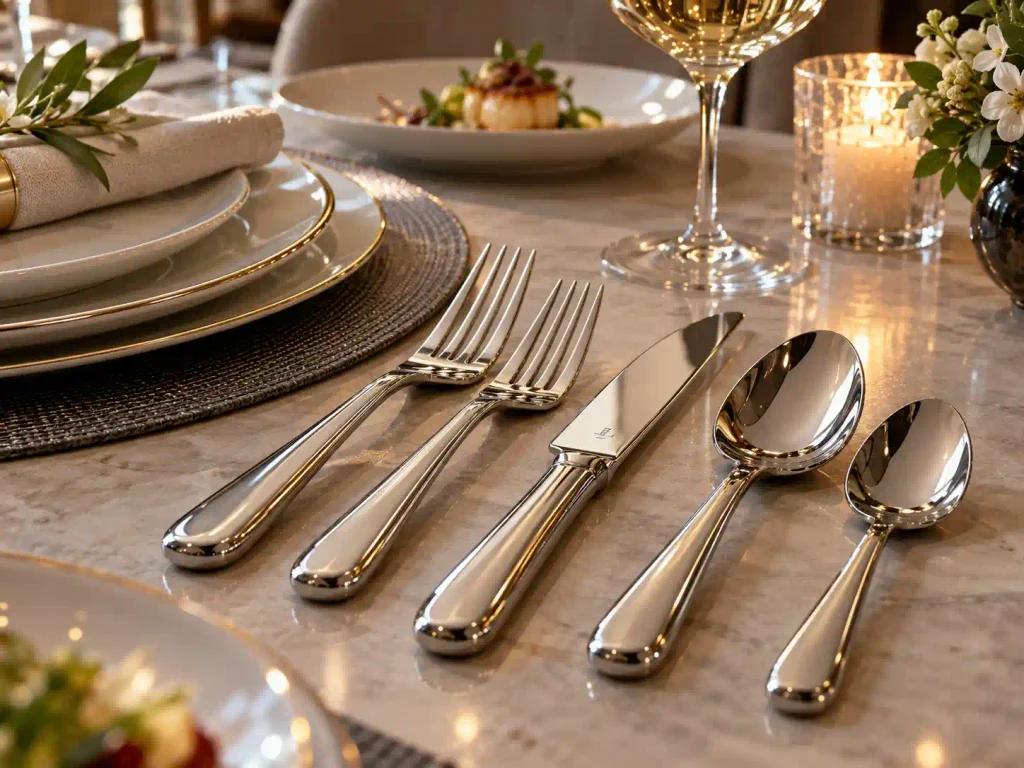
You must be one of the few who are on the lookout for non toxic silverware. Most people are concerned about the ingredients in their meals, but they seldom think about the material of the spoon, fork, or knife they use every day.
The issue is important, particularly when children are sharing the family table.
Silverware is not just about a beautiful pattern, attractive finish or a comfortable grip. Its material is important too. Some materials can corrode, some decorative finishes may wear away, and certain substances can be transferred from the metal surface into the food.
This is why the quest for non toxic flatware merits more attention than a simple comparison of stainless steel grades. However, determining whether a silverware set is non toxic is not as simple as looking at a single factor; it requires a holistic approach.
Certain questions might cross your mind when thinking about the toxicity of flatware: Is nickel in silverware toxic always? Is 18/0 stainless steel flatware always better than 18/10 in respect of toxicity of metal? However, these questions do not provide conclusive answers in your search for non toxic cutlery.
In this article of best picks of flatware, we explain the science of possible toxicity in cutlery in simple terms. We also compare two non toxic silverware sets: Made In’s Italian flatware and Liberty Tabletop’s American Outdoors collection.
🔬 What Does Non Toxic Silverware Actually Mean?
It’s true that the phrase “non-toxic silverware” can sound straightforward, however, there is no specific type of stainless steel with this designation.
The product is not necessarily safe if the manufacturer labels the product as “non-toxic.” The use of nickel and/or chromium in stainless steel does not automatically create a health risk.
There are three main things to consider:
Material composition: Which metals and other substances are present?
Chemical migration: Can any of these substances migrate from the utensil into the food?
Exposure: How much could a person take in the contaminant during normal use?
These points have close relation, but they are not the same.
For instance, 18/10 stainless steel contains nickel; however, the nickel is an element in the alloy and therefore does not represent a “coating” of nickel on the outside of the steel.
Stainless steel items that are made correctly have an outer layer that protects against rust. For this reason, stainless steel is commonly used for equipment that comes into contact with food.
The Food and Drug Administration (FDA) of the United States assesses the regulatory status of each food contact substance based on the product’s intended use and the relevant regulatory approvals. The assessment process includes evaluating the extent of migration from the food contact material to the food product and the potential level of consumer exposure that may result.
In addition, the European Directorate for the Quality of Medicines & HealthCare (EDQM) provides technical guidance regarding the use of metals and alloys in food contact applications. The guidance identifies which elements could potentially be released from the material and provides a limit for how much of each element may be released.
The main issue with determining if there is a safety risk from using metal utensils is not only identifying what types of metals were used to manufacture the utensil but also whether those metals will move from the utensil into the food to an extent that poses a risk to human health.
⚠️ Which Materials Can Make Flatware Unsafe?
Not every metal is equally suitable for contact with food. Some materials are generally considered safe, while others require special care, protective coatings, or certain usage restrictions.
Here are the main materials and substances worth knowing about:
| Material or Substance | Potential Concern | What to Look For |
|---|---|---|
| Lead | Can harm the brain and nervous system, particularly in children | Reliable lead-content and migration information |
| Cadmium | Can damage the kidneys, bones and respiratory system | Appropriate contaminant controls |
| Nickel | Can trigger allergic reactions in sensitive people | Suitable alloy and controlled release |
| Chromium | Behaviour depends on its chemical form and exposure | Stable stainless steel surface |
| Copper and Brass | Can release copper and other metals under certain conditions | Food-contact suitability for the intended food |
| Lead-Containing Pewter | Can expose users to lead | Avoid lead-containing food-contact alloys |
| Poorly Documented Coatings | May wear, peel or release unwanted substances | Clear coating composition and food-contact documentation |
Under the FDA Food Code there are some types of material that may not be used for contact with food. These include materials such as lead-containing pewter and solder that contains lead. Additionally, the use of copper or brass in direct contact with acid-based foods is restricted depending upon how the food is prepared.
The fact that certain types of metal can cause problems when used to make kitchen utensils doesn’t mean all utensils (like silverware) made from those metals are going to be harmful. Instead, it means the materials being used for the utensils and how the utensils will be used need to match.
The next critical contaminant that we should take into account is Cadmium. According to the World Health Organization, the primary areas where Cadmium may cause damage include: the kidney, bones and lungs.
When choosing everyday flatware, it is recommended to use a clearly specified stainless steel alloy manufactured by a company which provides useful material information.
👶 Why Non Toxic Silverware Matters for Children
Choosing eating utensils for children deserves particular care.
Children under the age of five years are currently undergoing development, and their brain and nervous systems are particularly susceptible to exposure to some types of environmental pollutants.
The use of lead is a significant issue. There is no such thing as an acceptable blood lead level in young children according to the Center for Disease Control. Even with very low levels of exposure, lead can have negative impacts on a child’s ability to learn, concentrate and develop.
I am not trying to imply that typical stainless steel flatware is frequently contaminated with lead. Instead, I’m providing an explanation as to why parents need to be concerned about the materials being used to make products which will ultimately be in contact with food.
Before buying children’s silverware, consider the following:
- Choose utensils made from clearly identified food-contact materials.
- Prefer manufacturers that provide information about lead and other contaminants.
- Avoid poorly documented decorative coatings.
- Do not use utensils with peeling finishes, deep corrosion, or damaged surfaces.
- Choose smooth edges and an appropriate size for the child’s age.
- Keep sharp dinner knives away from young children.
Stainless steel sets are a good option for families who dine together because they are durable enough to last for years. However, when you have young kids (toddlers) or babies, using utensils that are specifically sized and designed for their small hands and developmental stage will likely work better than a standard-size set.
A valuable distinction: A set of flatware can be constructed of appropriate materials for use with food but not intentionally designed to accommodate children. When selecting utensils for young children, both the composition of the product and how it was designed must be taken into account.
🧪 Is 18/10 Stainless Steel Non Toxic Even Though It Contains Nickel?
This is probably the most misunderstood part of buying non toxic flatware.
In general, 18/10 stainless steel is safe to use on a daily basis for preparing and storing food, regardless of its nickel content.
Let’s understand why.
What do 18/10 and 18/0 actually mean?
The numbers give an approximation of how much chromium and nickel are contained in the stainless steel.
• 18/10: Approximately 18% chromium and 10% nickel.
• 18/8: Approximately 18% chromium and 8% nickel.
• 18/0: Approximately 18% chromium and no intentionally added nickel.
The British Stainless Steel Association states that the two types of cutlery, 18/8 and 18/10, are made from the same 304 stainless steel. There is little difference between the 18/10 label and the 18/8.
18/0 is commonly associated with grade 430 stainless steel.
Why is chromium important?
Stainless steel resists corrosion primarily because of chromium.
When the surface gets exposed to oxygen, chromium forms a thin protective oxide layer. That layer protects the underlying metal from corrosion.
The use of nickel is also very significant in many types of stainless steel. The addition of nickel contributes to the overall structure and properties that allow the resulting stainless steel to be both durable and corrosion-resistant.
Therefore, nickel is not necessarily a bad thing to have around.
Does nickel migrate into food?
Release of nickel can occur, however, it varies depending upon the type of alloy used, the state of the surface, how acidic the environment is, what the temperature is, and for how long there has been contact.
The scientists conducted a study on 120 food service utensils made from stainless steel that they bought through an online store in 2021. They tested how much of several metals, including chromium, nickel, aluminium, iron, manganese, copper, zinc, and molybdenum, migrated from the utensils into food simulants.
Some of the tested samples had levels of migration that exceeded the maximum migration limit specified in Nordic guidance. However, there was no indication of severe adverse health outcomes based upon the exposure assessment of the researchers for the estimated exposure levels.
This study reveals that nickel migration from stainless-steel utensils can occur, but well-made stainless-steel flatware is unlikely to pose a significant health concern for most users.
However, individuals who have been identified as having an allergy to nickel may require further attention. They may be sensitive and will react to the presence of nickel.
Is 18/0 safer than 18/10?
Not necessarily.
18/0 contains no added nickel, therefore, it may interest those buyers (having sensitivity) that wish to reduce their exposure to nickel.
18/0, although a general rule, typically provides less protection from corrosion than 18/10. Therefore, 18/0 cannot be assumed to provide superior safety in all types of food contact applications.
For the majority of homes, a well-made 18/10 or 18/8 stainless steel kitchen tool will provide a good daily use choice, since better corrosion resistance generally helps maintain the protective surface that limits metal migration, although not in every food-contact situation.
If you want to understand the differences in greater detail, read our guide: 18/0 Stainless Steel Flatware: Is It Good Enough for Everyday Use?.
Our Featured 2 Best Non Toxic Flatware Sets
To be honest, there is no such thing as a universally recognized category of non toxic flatware brands. However, considering different aspects of the material construction, we presenting the following two best non toxic silverware brands:
Made In — Best for detailed material and safety disclosures
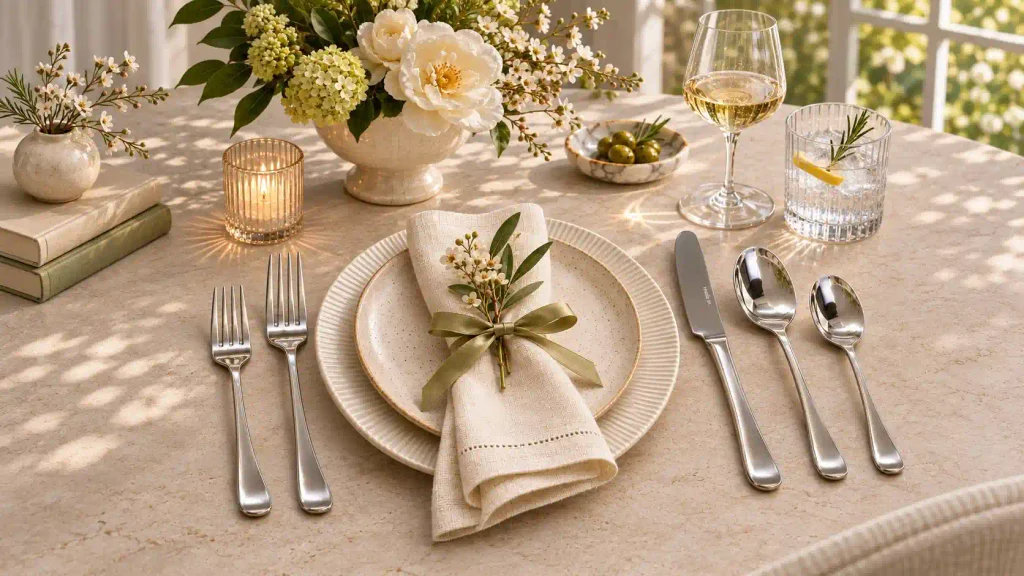
The manufacturer identifies different stainless steel grades for its forks, spoons, and knives. It also publishes a list of substances excluded from its tabletop products and states that they are third-party tested for safety.
Liberty Tabletop American Outdoors — Best for American manufacturing and material traceability
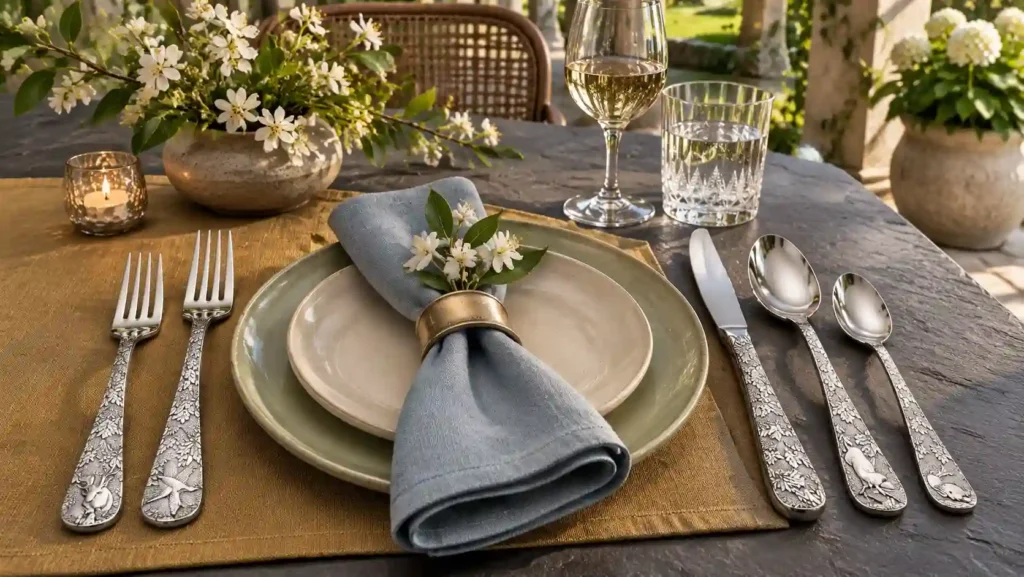
Liberty describes its use of American-sourced 18/10 stainless steel and explains its mill-certification process. The collection also has a distinctive wildlife-inspired design.
Detailed Review of 2 Best Non Toxic Flatware Sets
🏆 1. Made In — First Of Best Non Toxic Flatware Brands for Detailed Material Disclosures
The Made In flatware set combines a simple polished design with a particularly useful material distinction.
It is made in Italy and provides four complete five-piece place settings.
What makes it interesting for this article is that the manufacturer does not use exactly the same stainless steel grade for every utensil.
Specifications of Made In Flatware Set
| Feature | Details |
|---|---|
| Brand | Made In |
| Set Name | Classic 20-Piece Flatware Set |
| Set Size | 20 pieces |
| Service | 4 people |
| Recommended Use | Fine dining |
| Forks and Spoons | 18/10 stainless steel |
| Knives | Single-piece 18/0 stainless steel |
| Finish Type | Polished |
| Color | Silver |
| Style Name | Formal |
| Country | Italy |
| Care | Dishwasher safe |
| Additional Features | Corrosion resistant |
| Item Weight | 3.05 pounds |
| Warranty | See manufacturer warranty information |
Why does its material construction stand out?
Made In specifies 18/10 stainless steel for its forks and spoons.
The most common application of this type of metal is for high-end flatware, as it provides both an attractive appearance (bright) and excellent protection against corrosion.
The knives are produced using one continuous piece of 18/0 stainless steel. I find this to be an intriguing design option since the mechanical requirements for producing knife blades differ from those used in producing forks and spoons.
As its evidence of being nontoxic silverware, the manufacturer will additionally publish a Safety and Health Statement regarding the non-existence of:
• PFAS
• PFOA
• PTFE
• Lead
• Cadmium
• Aluminium
• BPA
The set can safely be described as non toxic lead free flatware. Made In also reports that all of their tabletop products are tested by an outside organization to ensure that they meet standard safety requirements.
These disclosures provide buyers with more than just a general statement about “premium stainless steel,” but rather specific details that are helpful to the buyer.
It is essential to recognize that although 18/0 knives do not contain nickel throughout the entire set, the forks and spoons are made from 18/10 stainless steel.
This may be considered the safest silverware or the healthiest flatware.
Design and everyday use
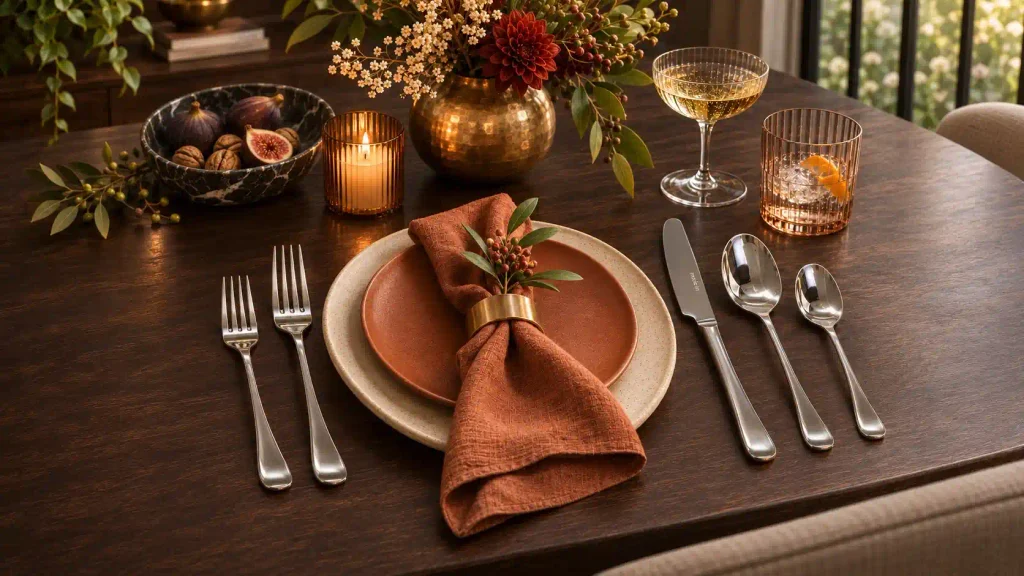
The design is simple and polished. The handles have smooth contours without elaborate decoration.
This makes the set easy to pair with different dinnerware styles.
The 20-piece collection includes:
- Four dinner forks
- Four salad forks
- Four table spoons
- Four dessert spoons
- Four dinner knives
The five-piece arrangement for each person makes it suitable for a household of four.
The polished finish also gives it a more formal appearance than many basic everyday silverware sets.
Durability and maintenance
Finishes of Made In is resistant to staining and corrosion.
To keep the shine and protective capability of this non toxic stainless steel flatware, it is important to remove food residues rather than leaving utensils wet or dirty for long periods
The set is dishwasher safe and backed by a warranty from the manufacturer. Of course, Amazon provides its flexible return policy.
Strengths and Weaknesses of this Nontoxic Flatware Set
Advantages
• Clear 18/10 and 18/0 material specifications
• Manufacturer disclosures covering several substances of concern
• Third-party safety-testing statement
• Made in Italy
• Dishwasher safe
• Lifetime warranty
• Simple design suitable for everyday and formal dining
Disadvantages
• Higher price than the Liberty Tabletop set
• The 18/10 components contain nickel
• The polished finish may show fingerprints and water spots
Who Should Consider It?
Made In is worth considering if you want a well-documented stainless steel flatware set with a mixed-grade construction and a manufacturer that provides detailed material information.
For families, its published disclosures concerning lead and cadmium are particularly relevant.
Bottom line: Made In is a leading chemical free silverware set and it offers a useful combination of identifiable alloy grades, manufacturer safety disclosures, and practical everyday construction.
🥈 2. Liberty Outdoors — Second Of Best Non Toxic Cutlery Set for American Manufacturing and Material Traceability
The Liberty Tabletop American Outdoors set takes a different approach.
What makes this product so attractive is both the stainless steel design, and the manufacturer’s documentation regarding the origin of their steel and how they document that process.
The products in this collection are produced in Sherrill, NY from U.S. sourced 18/10 stainless steel.
It also has a distinctive wildlife-inspired design.
In case you are interested in exploring more American-made options, check out our guide to the best flatware made in the USA.
Specifications of Liberty Tabletop American Outdoors Flatware Set
| Feature | Details |
|---|---|
| Brand | Liberty Tabletop |
| Pattern | American Outdoors |
| Set Size | 20 pieces |
| Service | 4 people |
| Included Pieces | 4 dinner forks, 4 dinner knives, 4 place spoons, 4 teaspoons and 4 salad forks |
| Material | American-sourced 18/10 stainless steel |
| Finish Type | Hammered |
| Finish | Mirror with hammered texture |
| Color | Mirror |
| Style Name | Casual |
| Recommended Use | Outdoor dining |
| Country | USA |
| Care | Dishwasher safe |
| Additional Features | Corrosion-resistant 18/10 stainless steel; unique hammered design; made in USA |
| Item Weight | 2.6 pounds |
| Warranty | 25-year manufacturer’s warranty |
What makes its material information useful?
Liberty Tabletop confirms that they get all of their stainless steel from U.S. mills.
The manufacturer states that they provide certification reports with each mill which contain:
• Country of origin of the steel melt
• Exact chemical composition
• Mechanical properties
• Testing information for trace elements such as lead and mercury
The value of this information comes from the fact that the manufacturer provides a description of the documentation process for the materials used to create the final product (flatware).
Liberty says that they do not clean with TCE at their manufacturing site. They use soap and water to clean.
TCE is a commercial solvent that the United States Environmental Protection Agency considers a major threat to human health.
The manufacturing disclosures help readers gain insight into how the organization obtains materials and produces products. This goes a long way in establishing this as a non toxic flatware set.
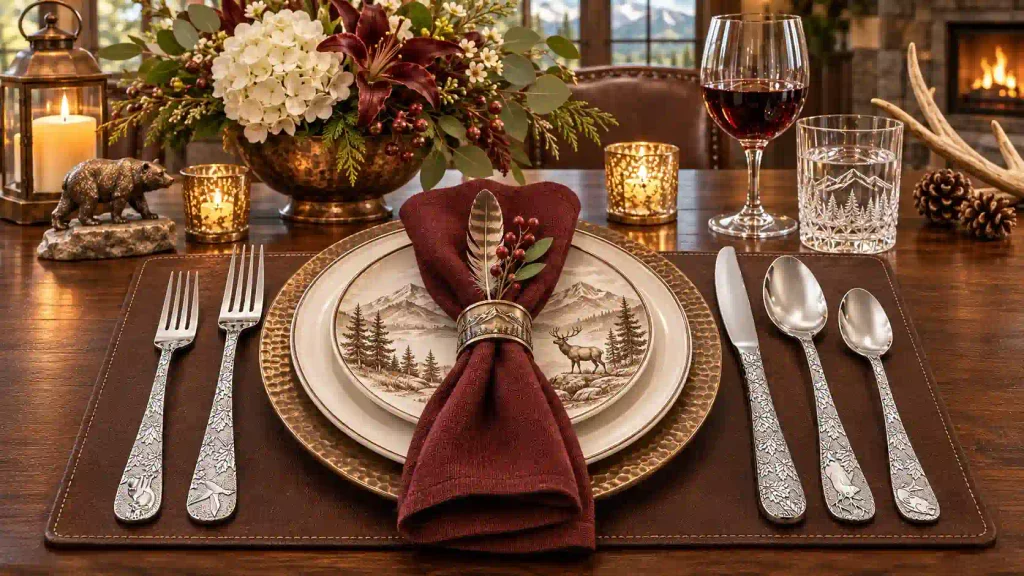
The American Outdoors pattern
This is not an ordinary plain stainless steel design.
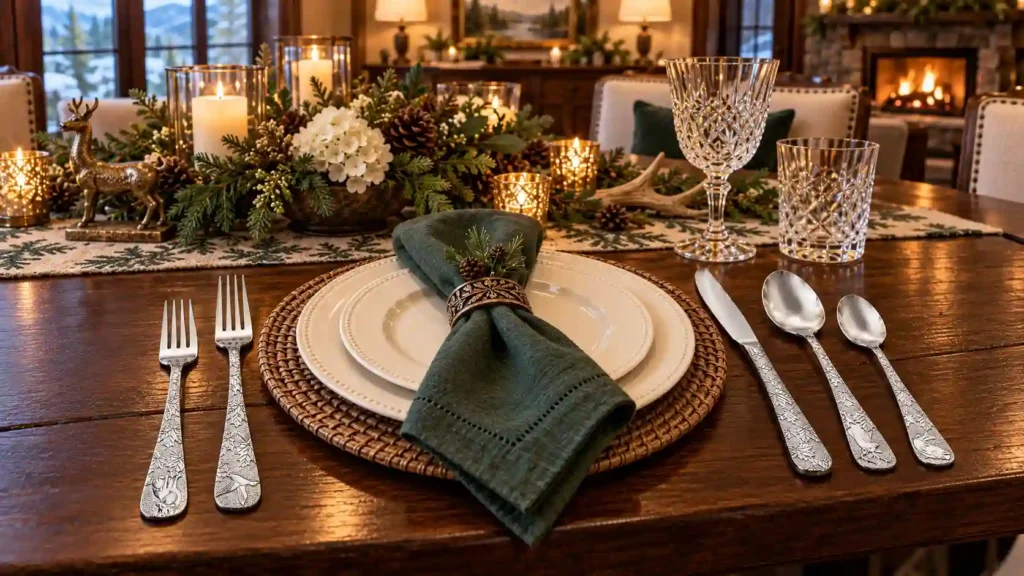
Each item has an individual wildlife engraved design on a textured surface.
The individual motifs are as follows:
• Dinner fork: A deer beneath forest foliage.
• Salad fork: A woodland bird among branches and leaves.
• Place spoon: A duck in flight.
• Teaspoon: A rabbit among leaves.
• Dinner knife: Flowing foliage and textured outdoor details.
The hammered-style finish gives the handles additional depth and creates a distinctive look compared with traditional polished flatware designs.
The end product is a line of pieces that look very different than typical plain silver-colored eating utensils.
Set contents and performance
The 20-piece collection provides service for four.
It includes:
• Four dinner knives
• Four dinner forks
• Four salad forks
• Four place spoons
• Four teaspoons
This product is “dishwasher safe”. The dinner knives are made of forged steel with serrated edges.
Because the pieces are made to fit the European size standard, they may appear a bit larger than many American-sized flatware options.
Why consider its 18/10 construction?
The collection is made of premium American-sourced 18/10 stainless steel.
The composition of this alloy includes both chromium and nickel. Chromium-rich passive surfaces help prevent corrosion of the steel, whereas nickel improves the alloy’s durability, corrosion resistance, and ability to maintain a bright, polished appearance.
As noted above, having nickel in utensils does not necessarily render them poisonous.
The fact that Liberty has material specifications and sourcing information makes this collection especially relevant for consumers who want to know about how their products were manufactured.
A simple fact that is helpful to know is that Liberty’s Mill Certification states the chemical makeup of the steel, as well as the control of trace elements. Individuals who may have certain medical sensitivities can ask for additional technical information from the manufacturer.
Strengths and Weaknesses of this Nontoxic Silverware Set
Advantages
- American-sourced 18/10 stainless steel
- Manufacturer-described mill certification
- Trace-element testing information
- Made in the USA
- Distinctive wildlife-inspired handles
- Dishwasher safe
- 25-year manufacturer’s warranty
- Lower Amazon price than the Made In set in the supplied listing
Disadvantages
- The decorative handles may not suit minimalist dining rooms
- The textured finish may require a little more attention during cleaning
- Contains nickel as part of the 18/10 alloy
- The Euro sizing may not suit everyone
Who should consider it?
Liberty Tabletop American Outdoors should be considered by individuals that care about American-made goods, where their products come from, and unique dinnerware.
Families that are looking for a more decorative option than the usual stainless steel silverware would likely find it interesting as well.
Bottom Line: This is an excellent option for daily family dining due to its use of U.S. sourced 18/10 stainless steel, the manufacturer’s mill certification, and the unique individual wildlife design on the handles.
📊 Side-by-Side Comparison: Made In vs. Liberty Tabletop
| Feature | Made In | Liberty Tabletop |
|---|---|---|
| Main steel grade | 18/10 (forks and spoons), 18/0 (knife blades) | 18/10 stainless steel |
| Nickel | Present in 18/10 components; absent from 18/0 knife blades | Present in 18/10 construction |
| Lead disclosure | Manufacturer states no lead | Mill certification and material documentation available |
| Cadmium disclosure | Manufacturer states no cadmium | Not specifically stated in the reviewed documentation |
| Material documentation | Published material specifications | Mill certification process described |
| Third-party testing statement | Yes | Not established from the reviewed documentation |
| Country | Italy | USA |
| Design | Polished minimalist design | Wildlife engraving with a hammered texture |
| Dishwasher safe | Yes | Yes |
The two sets offer different strengths.
Made In provides a more detailed list of substances excluded from its tabletop products. Liberty offers a particularly useful explanation of its American steel sourcing and mill-certification process.
Neither material grade alone proves zero metal migration under every possible condition.
🛒 Best Non Toxic Flatware Amazon Listing

- Includes: 4 pc Dinner Fork | 4 pc Salad Fork | 4 pc Table Spoon | 4 pc Dessert Spoon | 4 pc Dinner Knife
- Table for Four – the Made In Flatware Set includes four elegant place settings with five individual pieces each, totaling 20 pieces altogether
- Durable Design – With a unique technique created by our artisans, this Flatware is more durable and more stain resistant than other silver-plating methods
- High-Performing Materials – These forks and spoons are constructed of 18/10 stainless steel, which helps prevent corrosion and keeps your silverware spotless

- FINEST QUALITY 18/10 STAINLESS STEEL: Liberty Tabletop ONLY uses the highest quality stainless steel. All materials responsibly sourced domestically
- 100% MADE IN USA: Liberty Tabletop flatware is made in Sherrill NY. The ONLY FLATWARE MANUFACTURER in the USA
- 25 YEAR MANUFACTURERS WARRANTY: Liberty Tabletop proudly stands by our quality. Our goal is to provide a high-quality product for our valued customers
- DISHWASHER SAFE: All Liberty Tabletop flatware is dishwasher safe. Additionally, because we only use 18/10 stainless steel our flatware WILL NEVER RUST
🏆 Final Verdict: Which Non Toxic Silverware Should You Choose?
Choosing non toxic silverware doesn’t require looking for a product that says “non-toxic” on the label.
Understanding the material, the manufacturing process used to create it, and whether it can be safely used over and over again with food are actually the factors that determine the selection of a non toxic stainless steel silverware set.
Made In and Liberty Tabletop offer two best non toxic stainless steel silverware sets, of course, in somewaht different ways.
Made In provides specific details regarding stainless steel specifications and publishes a list of ingredients that are excluded from their table top products. It is important to know why Made In uses a combination of 18/10 forks and spoons along with 18/0 knives.
Liberty Tabletop’s American Outdoors is made from American-sourced 18/10 stainless steel. The company refers to “mill certification” about non-toxicity. American Outdoors features an original, wildlife-inspired pattern – different creatures on different pieces.
Made in may be worth consideration for customers who are looking for a complete disclosure of the materials used to create products. On the other hand, Liberty Tabletop would be a good option for people who value American made products and have an interest in tracking where the steel was manufactured.
The flatware your family uses daily is just as deserving of careful consideration as the food placed upon it. Therefore, make your decision carefully. Buy or check price of the above-mentioned healthiest silverware to use:
Note: As an Amazon Associate, we earn from qualifying purchases at no extra cost to you.
❓ Frequently Asked Questions
1. What is the safest silverware to use every day?
Properly manufactured, uncoated stainless steel flatware with clearly identified material specifications is a practical everyday choice. Look for transparent information about its composition and food-contact suitability.
2. Is 18 10 flatware toxic?
18/10 stainless steel is widely used for everyday flatware. It contains chromium and nickel, but the presence of nickel does not automatically make the alloy toxic. Its suitability depends on the quality of the finished product and its intended use.
3. Is nickel in silverware safe?
Most people can use properly manufactured nickel-containing stainless steel utensils without a problem. It is generally safe. However, nickel can cause allergic reactions in sensitive individuals. People with diagnosed nickel allergies should seek suitable alternatives.
4. Is 18/0 stainless steel safer than 18/10?
Not automatically. 18/0 does not intentionally contain nickel, but it generally has lower corrosion resistance than 18/10. The choice depends on individual needs and product quality.
5. Does stainless steel flatware contain lead?
Lead is not an intended alloying element in ordinary 18/10 stainless steel. However, buyers should look for reliable manufacturer information about contaminant controls rather than assuming every product has identical composition.
6. Is non-toxic flatware important for children?
Yes. Children are more vulnerable to lead exposure because their brains and nervous systems are still developing. Choosing well-documented food-contact utensils is a sensible precaution.
7. Is gold flatware safe to use?
Gold-colored flatware is not automatically unsafe. Its suitability depends on the underlying metal, the coating material, manufacturing quality, and surface condition. Look for manufacturer information about food-contact use.
8. Is black stainless steel silverware safe?
It can be suitable for everyday use if its coating and underlying material are appropriate for food contact. Check the manufacturer’s information and avoid pieces with damaged or peeling finishes.
If you are considering different colors and finishes for your dining table, explore our selection of the best black silverware sets for 8 to find a style that suits your preferences.
9. What is the difference between nickel-free and non-toxic silverware?
Nickel-free describes the material composition. Non-toxic is a broader safety claim that must consider the other materials present, possible migration, and exposure. Nickel-free does not automatically mean safer in every respect.
10. Are Made In and Liberty Tabletop silverware sets lead-free?
Made In states that its tabletop products are made without lead and cadmium, among other substances. Liberty describes testing of trace elements, including lead and mercury, in its mill-supplied steel. These are manufacturer disclosures and should be interpreted according to their stated scope.
11. Is chemical-free silverware possible?
No material is literally chemical-free. Stainless steel itself is an alloy of chemical elements. The sensible goal is to choose materials that are suitable for food contact and do not release harmful amounts of unwanted substances.
12. How should I clean stainless steel silverware?
Follow the manufacturer’s care instructions. Most conventional stainless steel flatware can be washed in a dishwasher. Remove food residues, avoid prolonged exposure to salty or acidic deposits, and dry utensils before storing them if water spotting is a concern.
13. Does stainless steel silverware contain nickel?
There is no conclusive answer to the question. If the stainless steel is of the grades 18/10 or 18/8, it does contain nickel. On the other hand, if the stainless steel is marked as 18/0, it does not contain nickel.
14. Does stainless steel silverware contain lead?
No. Stainless steel flatware does not contain lead.
Discover more from Flatware Finesse
Subscribe to get the latest posts sent to your email.