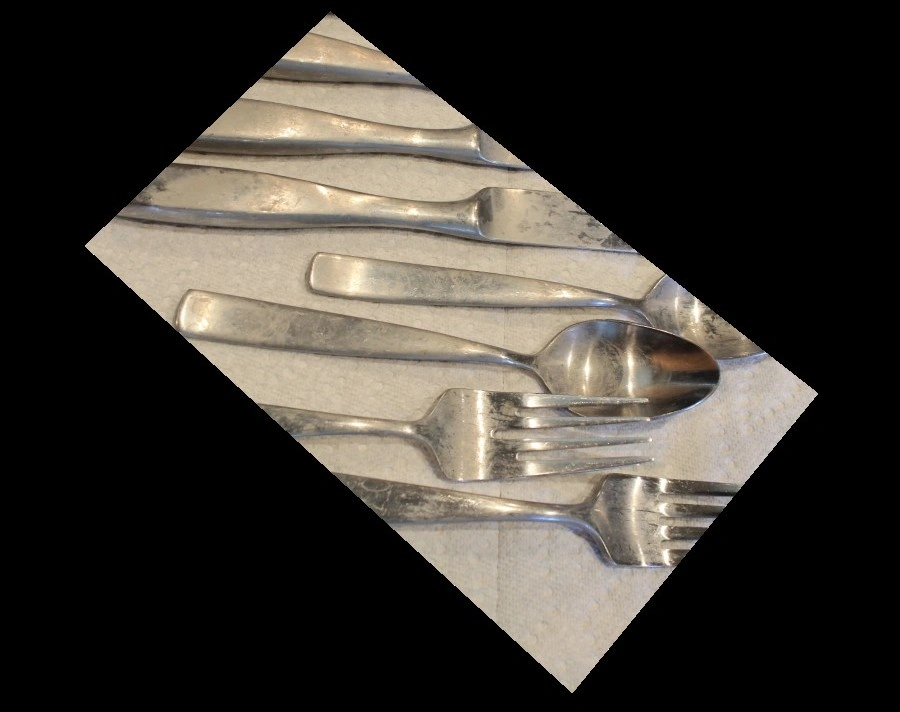
You scrub, you rinse and you rely on your dishwasher for cleaning your knives, forks and spoons. But week in and week out, no matter how big your rinse rack is or what kind of dish soap you use, every time you unload it all, there they are: the same maddening constellation of cloudy white water spots on silverware. There is nothing wrong with the washing machine you’ve been using.
You might think it’s a kind of personal failure, a fight you can’t win. The scary part is that the same water supply feeding your machine is the very water you drink—considered safe and high quality, yet still leaving spots. Even if you accept silverware always gets spots, whether you bought your silverware a year ago or snagged it from eBay last week, there is one more ontological mystery every homeowner faces: Are these spots just a passing eyesore, like the lint that clings to your clothes straight from the dryer, or are they signs of slow-motion entropy slowly turning your silverware into garbage? Read on to discover if silverware water spots are inevitable scars or solvable stains.
🕵️♂️The Real Culprit: It’s Not Dirt, Is It Your Water?
Let’s clear one thing up immediately. Those cloudy spots and films aren’t a sign of poor hygiene. In fact, they appear after the cleaning process is done. What you’re seeing is the ghost of a water droplet—a deposit of minerals left behind after H2O evaporates.
Think of it like this: when you boil water in a kettle, you see a white, chalky scale build up over time. The same principle is happening on a microscopic level with every single water droplet that dries on your flatware. The primary minerals involved are calcium and magnesium, and the concentration of these in your water determines just how bad your spot problem will be. This brings us to the core issue: water hardness.
Hard water is simply water with a high mineral content. It’s a natural result of water passing through limestone and chalk deposits in the ground. Hard water stains on cutlery is always difficult to remove. It’s not dangerous to drink, but it’s a nightmare for surfaces that need to sparkle. While not all municipal or well water is hard, vast regions of the United States, particularly the Southwest, Midwest, and Great Plains, struggle with significantly hard water.
But here’s the twist that catches many people off guard: You don’t need officially “hard” water to get spots. Even water classified as “moderately hard” or “soft” still contains dissolved minerals. If a droplet forms and dries, it can leave water stains on silverware. The frequency and severity are just higher with harder water.
This leads to a critical distinction that most people miss. The government regulates your water to be safe for drinking, meaning free of harmful bacteria and contaminants at levels that could make you sick. It says nothing about its cosmetic effects. Ironically, the very minerals that can make water healthy to consume are the same ones that wreak havoc on your flatware’s finish.
So, is there a truly harmless water for washing? Technically, yes. Distilled or deionized water, which has all minerals removed, will never, ever cause a water spot. But let’s be real—filling your sink or dishwasher with bottled distilled water is completely impractical and expensive for daily life. The conclusion is simple: we have to live with the water we have. The solution isn’t to find a new water source; it’s to outsmart the one we’ve got.
🤔The Damage Question: Are Water Spots Permanent?
This is the question that causes the most anxiety. Seeing those spots day after day, you start to wonder if you’re slowly ruining your favorite flatware set.
The good news is that in the vast majority of cases, water stains on utensils are a surface-level, cosmetic issue that is completely reversible. For most stainless steel and quality silverplate, those cloudy marks are just sitting on top of the metal’s polished finish. They are not rust that forms as a result of oxidation of the metal. They haven’t damaged the integrity of the metal itself.
However, there is a caveat. If these mineral deposits are left to sit for months or years on end, they can, in some cases, become more stubborn and potentially lead to a permanently dulled appearance. The minerals can slowly etch into the very top layer of the finish. Think of it like a glass shower door that was never cleaned—the scale builds up so thick that it becomes incredibly difficult to restore the original clarity.
So, while your spotted fork isn’t headed for the scrap heap tomorrow, consistent care is the key to ensuring your flatware retains its like-new brilliance for a lifetime. The goal is to tackle the spots before they decide to put down roots.
🛡️Prevention Playbook: Stopping Spots Before They Start
An ounce of prevention is worth a pound of cure, and that’s never truer than with water spots silverware. Integrating one or two of these habits into your routine will dramatically reduce, or even eliminate, the problem. Let’s see how to prevent water spots on silverware.
Your First Line of Defense: Rinse Aid
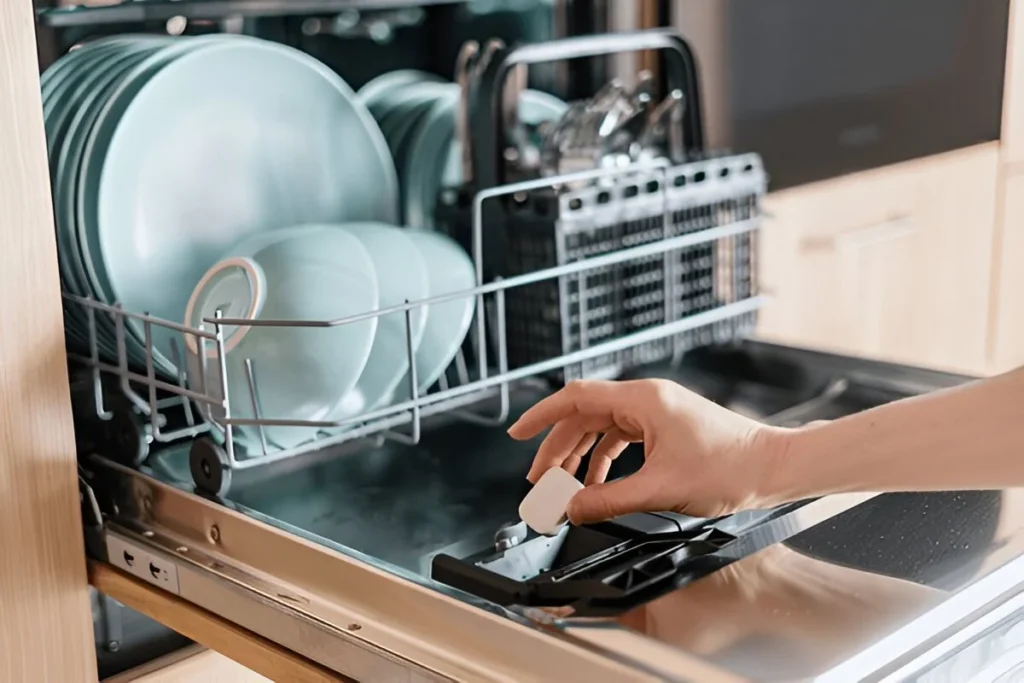
This is the easiest and most effective change you can make if you use a dishwasher. Indeed, water spots on silverware from dishwasher is quite common. Rinse aid is a chemical that reduces the surface tension of water. Instead of forming discrete, spot-forming droplets, the water sheets off your flatware in a thin film, draining away without leaving minerals behind. It’s a game-changer. Simply adding a quality Nature Clean All Natural Dishwasher Pods to your dishwasher’s dispenser can solve about 80% of the problem.
The Golden Rule: Instant Drying
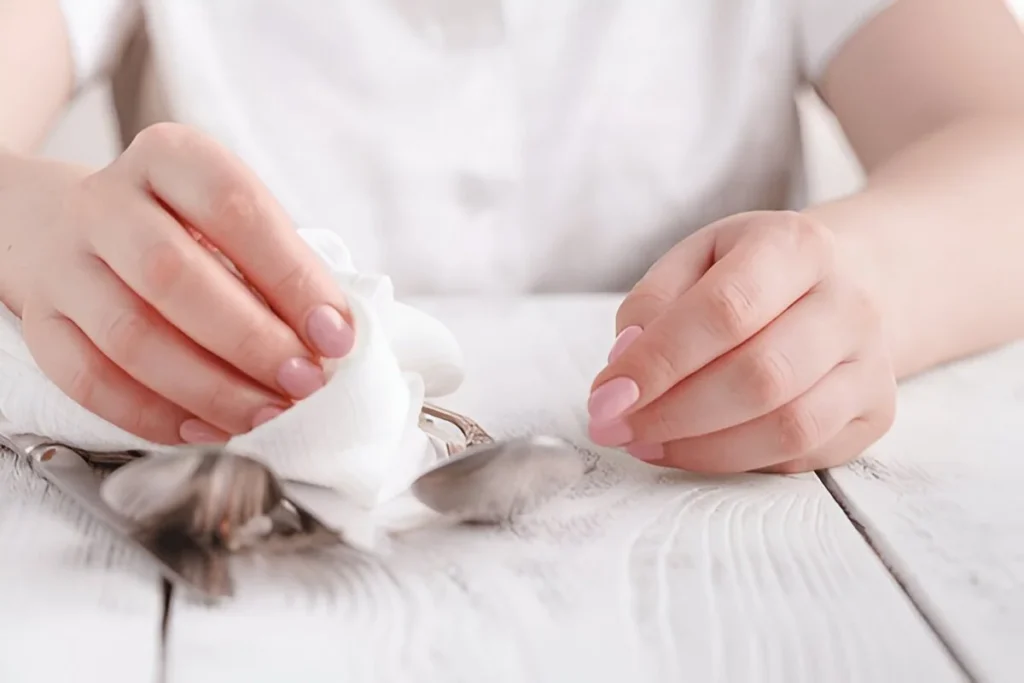
The single most effective method, period, is to never let your flatware air-dry. As soon as you wash and rinse it—whether by hand or machine—dry it immediately and thoroughly with a soft, lint-free cloth. This physically wipes away the water before it has a chance to evaporate and deposit its mineral load in the form of water marks on silverware. Keeping a stack of dedicated Microfiber Drying Cloths by your sink makes this simple.
Proper Dishwasher Loading
How you load the basket matters. Avoid nesting spoons and forks inside each other. When utensils nest, they trap water in little pockets, creating perfect conditions for spotting. Spread them out to ensure water can rinse and drain off freely.
🚀The Removal Rescue: How to Get Water Spots Off Silverware NOW
Already have a collection of spotted spoons? Don’t worry. Here’s how to remove water spots from stainless steel flatware and restore the shine.
For Stainless Steel & Everyday Flatware: The Vinegar Soak
White vinegar is your best friend answer to your question: how to remove water spots from silverware. Its mild acidity easily dissolves calcium and magnesium deposits.
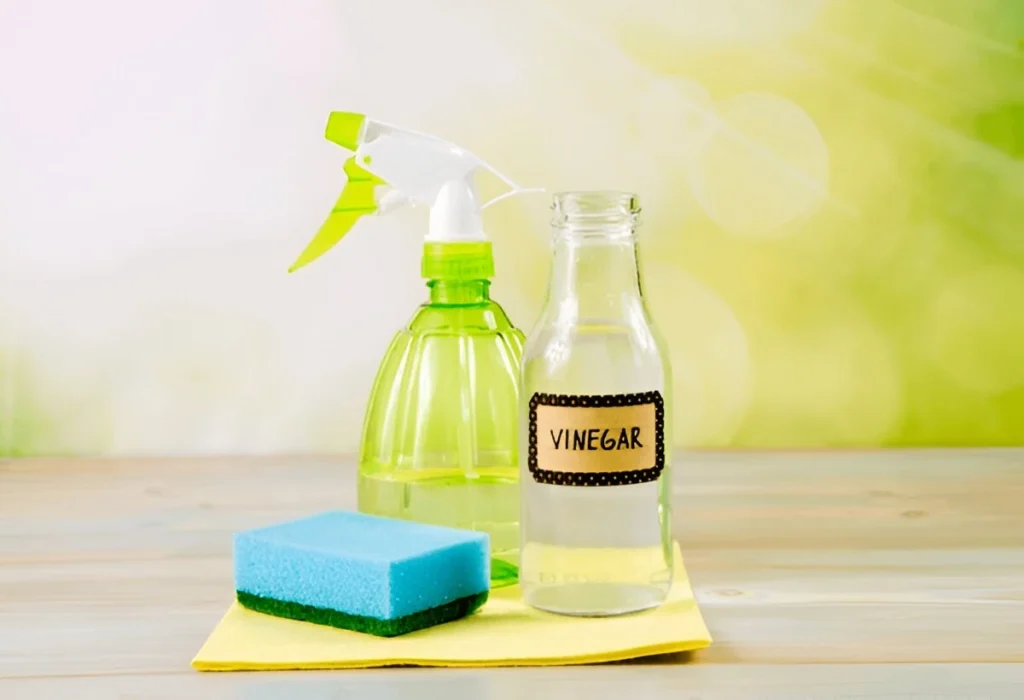
- Step 1: Fill a basin or your sink with one part white vinegar to three parts warm water.
- Step 2: Submerge the spotted flatware and let it soak for 5-10 minutes.
- Step 3: Remove the pieces. You should see the spots have vanished or significantly faded. Gently wipe with a soft cloth, rinse with clean water, and—this is crucial—dry immediately to prevent new spots from forming.
For Stubborn Films: The Baking Soda Paste
If a vinegar soak isn’t enough for a heavy film, a baking soda paste is a clear answer to the question: how to remove hard water stains from utensils.
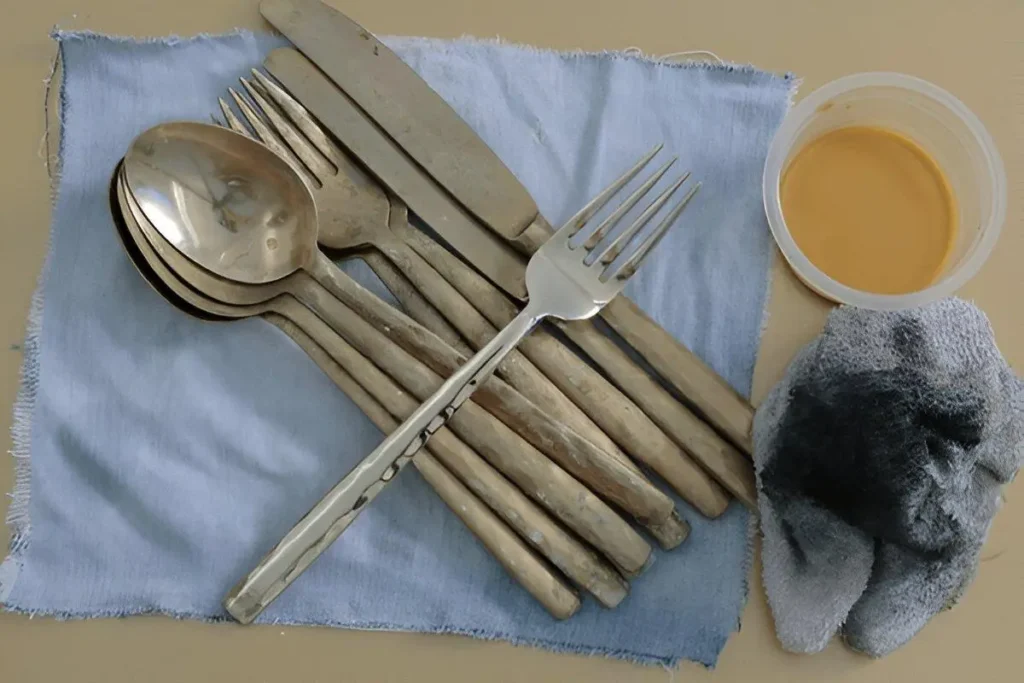
- Step 1: Make a thick paste from baking soda and a small amount of water.
- Step 2: Using a soft cloth or your fingers, gently rub the paste onto the spotted areas in a circular motion. Always rub with the grain of the metal if it’s visible.
- Step 3: Rinse thoroughly and dry immediately.
For Silver & Delicate Pieces: The Professional Polish
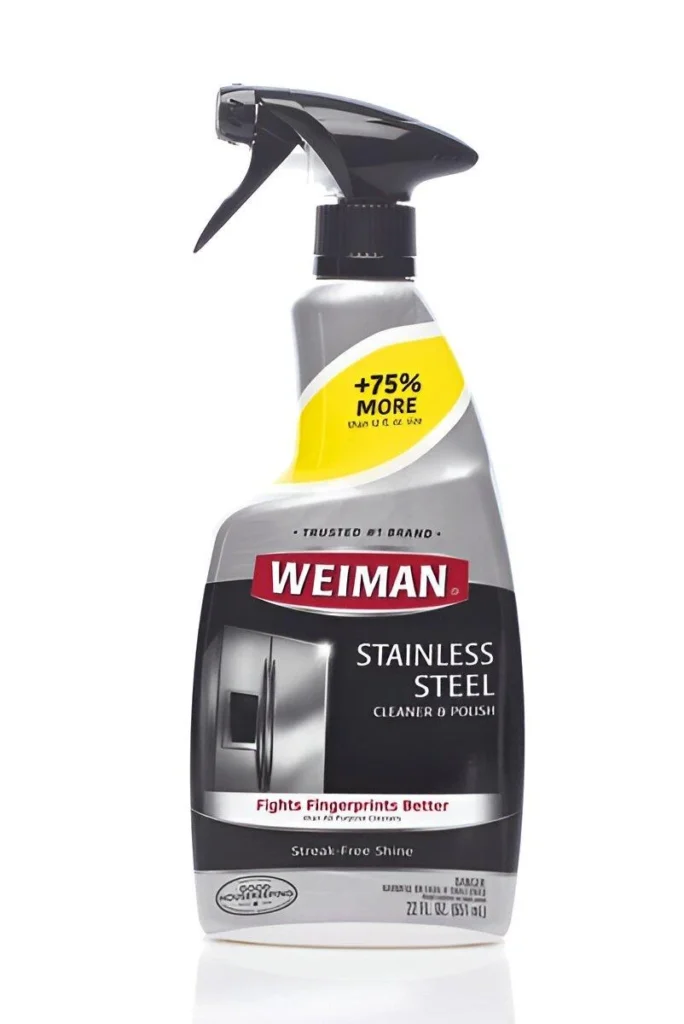
For sterling silver, silverplate, or heirloom pieces where you want a guaranteed shine without any risk of guesswork, a dedicated polish is the safest bet. A product like Weiman Silver Polish & Cleaner is formulated to remove both tarnish and water spots on cutlery without scratching. Apply with a soft cloth, buff to a shine, and then wash with soap and water to remove any residue before drying.
As an Amazon Associate, we earn from qualifying purchases. You do not pay a penny more.
📌Final Word
The battle against water spots is one you can absolutely win. It’s not about working harder; it’s about working smarter. By understanding the mineral enemy in your water and using these simple, targeted strategies, you can banish cloudy spots for good and finally have the sparkling table your meals deserve. For a deeper guide on keeping every piece spotless beyond just water spots, see our complete resource on how to clean silverware.
❓FAQ: Your Top Water Spot Questions, Answered
Q: Are water spots on silverware bad?
A: Primarily, they are a cosmetic issue. However, if left for years, mineral deposits can potentially etch into the finish, leading to a permanently dull appearance. Regular cleaning prevents this.
Q: I only get water spots from my dishwasher. Why?
A: Dishwashers use heated dry cycles, which bake the mineral deposits onto the surface. Combined with the high mineral content of hard water, this creates the perfect storm for spotting. Using a rinse aid and ensuring your dry cycle is functioning correctly is key.
Q: Can I use these methods on antique silver?
A: For valuable antiques, always err on the side of caution. Gentle hand-washing with a mild soap and immediate, thorough drying is best. Avoid vinegar soaks and abrasive pastes. For significant tarnish or spotting, consult a professional.
Q: Is “hard water stains on cutlery” the same as water spots?
A: Yes, essentially. “Water spots” is the common term for the initial, cloudy film. “Hard water stains” typically refer to more stubborn, built-up mineral deposits that have been left untreated for a longer period. The removal methods are similar, but stains may require a longer soak or stronger paste.
Q: What’s the one thing I can do to make the biggest difference?
A: Without a doubt, drying your flatware immediately after it is washed and rinsed. This single habit prevents the water from evaporating and leaving behind the minerals that cause spots.
Q: How do you get water spots off of silverware?
Water spots on silverware are mineral deposits from hard water, and you can remove them either by soaking the pieces briefly in white vinegar to dissolve the residue or by applying a gentle baking soda paste to scrub away more stubborn spots, then rinsing and drying thoroughly with a soft cloth to prevent new marks.
Discover more from Flatware Finesse
Subscribe to get the latest posts sent to your email.